vsRailway
Railway meters memory at $10 a gigabyte and CPU at $20 a vCPU. Here the machine has one price.
All three come from their own price list and their own documentation.
Railway's published rates are $20 per vCPU and $10 per GB of memory a month, for what the app uses. A partner VPS with those exact numbers starts at a few euros, and Deplo on top is free.
Every gigabyte a service sends out of Railway is $0.05, with none set aside for traffic. Deplo adds nothing per gigabyte: traffic is whatever your provider's plan says it is.
On Railway Pro a volume starts at 50 GB, stops at 1 TB, and a service can mount exactly one. Here a volume is space on your own disk, and an app mounts as many as it needs.
Railway's published rates are $20 per vCPU and $10 per GB of memory a month, for what the app uses. A partner VPS with those exact numbers starts at a few euros, and Deplo on top is free.
Every gigabyte a service sends out of Railway is $0.05, with none set aside for traffic. Deplo adds nothing per gigabyte: traffic is whatever your provider's plan says it is.
On Railway Pro a volume starts at 50 GB, stops at 1 TB, and a service can mount exactly one. Here a volume is space on your own disk, and an app mounts as many as it needs.

Three answers, two numbers. Theirs comes from their published rates; ours is a plan you can buy today.
$111/ month
3 GB of memory
$16.71/ month
CubePath gp.starter
8 GB of memory
Railway Pro numbers are their published rates, read on 8 October 2026. One always-on service is a gigabyte of memory on both sides: here half a vCPU and a gigabyte at their published rates, $20 a month. A heavier service costs more there and the same here. railway.com
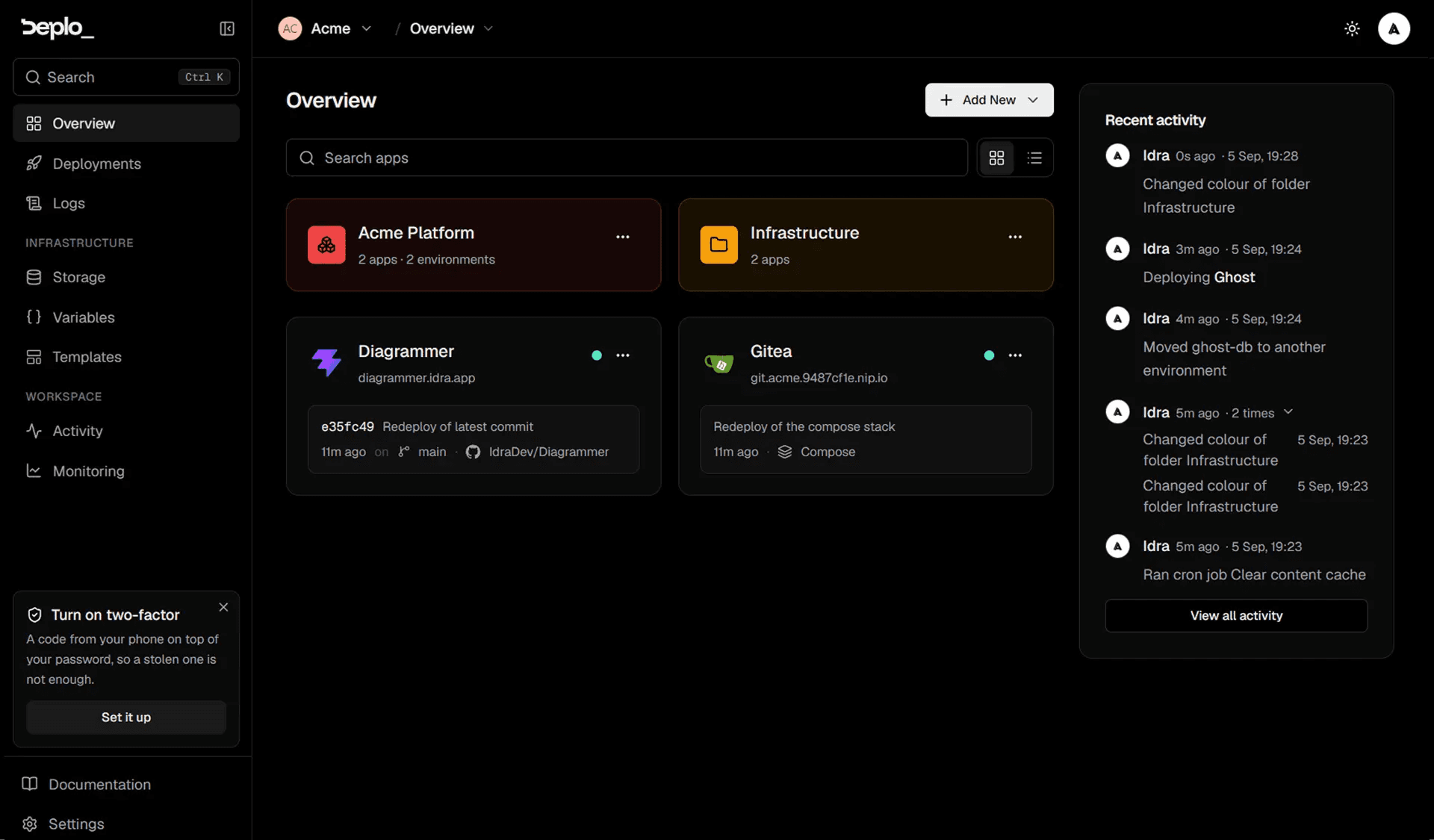
Click around a real Deplo on a real server for a few minutes. No email, no password, nothing to migrate yet.
Try the demoDeploys, backups, logs, metrics and TLS, already on. Nothing to buy on top, nothing to hunt down.
Ask, and it's done. Connect Claude, Cursor or any assistant that supports MCP, and it can deploy, read the logs and roll back when you ask in plain words. It works with a key you create and can revoke at any time, and it can never do more than you can. Nothing connects until you create a key, and one switch turns it off for the whole team.

Your whole release process becomes a push. Connect GitHub, GitLab, Bitbucket or Gitea once. Every push to your main branch goes live, every pull request on GitHub gets its own preview link that disappears when it closes, and a bad release goes back to the version that worked.

Your team works on the same apps without stepping on each other. Give each person exactly the access they need, like "can deploy, can't delete", and hand a freelancer or a client one project and nothing else. The activity timeline shows who did what and when, right in the dashboard.

Your app online without touching a setting. Connect the repo and you get a live link, and HTTPS the moment you add your domain. Deplo recognises your framework and builds it for you, and Postgres or Redis sits next to your app in two clicks. Same stack you ran on the cloud. Only the bill changed.

Where the money goes, and what you give up.
No. Below the first always-on service their free plan or the $5 Hobby plan, usage included, is cheaper than any server. The gap opens once something stays up around the clock: at $20 per vCPU and $10 per GB of memory per month, a 4 vCPU and 8 GB stack running flat out is $160 a month there, against a VPS with the same numbers for a few euros.
There is no import wizard for Railway today. In practice it is the same repository, the same variables and the same Dockerfile, or the same Railpack build: you point Deplo at the repo, set the variables again and deploy.
No. Deplo is free, and a server costs the same whether it is busy or idle. That is the trade: no meter and no surprise invoice, but no scale to zero either.
Databases are managed by Deplo on your own server, on the environment's private network, with scheduled backups encrypted before they leave. A volume is space on your disk: an app mounts as many as it needs, with no ceiling but the disk.
Answer three questions and pick a host, or install Deplo on a server you already have. It's free, and leaving is as easy as arriving. What you do with the money you save is your business.
 Railway